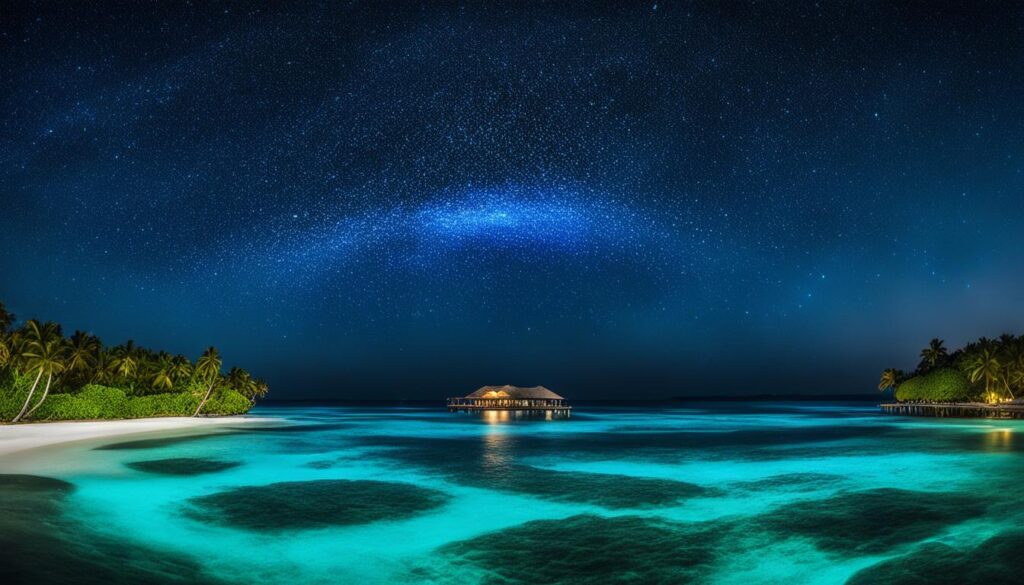
Sea of Stars — Vaadhoo Island, Maldives

On the tiny island of Vaadhoo in the Maldives, the ocean does something quietly extraordinary. When night falls, the waves begin to glow not metaphorically, but literally as if the stars have decided to descend from the heavens and rest upon the sea. Locals call it “The Sea of Stars.” Here, the horizon vanishes, and water becomes sky.
The Science Behind the Magic
The glowing blue waves are created by microscopic organisms known as
bioluminescent phytoplankton — specifically, a species of dinoflagellates. When disturbed by
motion — the crash of a wave, a swimmer’s movement, or even the touch of a hand — they emit a
bright electric-blue light. It’s a survival mechanism, a way to startle predators.
Ironically, what appears to us as an ethereal dreamscape is, in truth, the sea’s smallest creatures
fighting to stay alive.

Getting There
Vaadhoo Island is part of Raa Atoll, about 15 minutes by speedboat from Malé, the Maldivian capital.
Most visitors book night excursions through nearby resorts, though smaller guesthouses on the island
offer more personal experiences the kind where you can sit barefoot on the sand with a local fisherman
and listen to stories about the sea’s moods.
The best time to witness the phenomenon is between June and October, when the waters are warm and
plankton blooms are at their peak. Still, like all natural wonders, there are no guarantees the sea
shines on its own terms.
Stories and Myths of the Island
For generations, the people of Vaadhoo have told tales of spirits and stars living within the water.
Children were warned never to disturb the glowing tide, for it was said that the lights were the souls
of ancient travelers who had found rest at sea. While modern science may have replaced myth with
explanation, the islanders’ reverence for the glowing ocean remains — not as superstition, but as gratitude.
The Experience
The first step into the water feels like stepping through light. Each footfall sets off a shimmer that
dances across the sand. Some visitors laugh out loud; others stand silent, afraid that any sound might
break the spell. A gentle wave rolls in, and suddenly the entire shoreline is alive, a living galaxy
flowing at your feet.
To swim here at night is to become part of something cosmic. Your hands trail fire; your breath becomes
mist against the stars. The sea glows back, as if answering your heartbeat.
When Science Meets Emotion
Marine biologists say bioluminescence is the ocean’s oldest language a way of communicating long before
humans ever existed. And perhaps that’s why it moves us so deeply: it’s a reminder that we, too, come from light.
When we stand before the glowing sea, we’re not merely observers of beauty. We’re witnesses to life, ancient,
fragile, and infinite.
What the Sea Taught Me
The Sea of Stars taught me that beauty doesn’t need permanence to be powerful.
It appears, shimmers, and fades — yet its memory lingers.
Maybe that’s the real lesson: not every light is meant to last forever, but some are meant to change us while they do.


 ';
heart.style.position = 'fixed';
heart.style.left = Math.random() * 100 + 'vw';
heart.style.top = '-30px';
heart.style.opacity = Math.random();
heart.style.zIndex = 9999;
document.body.appendChild(heart);
hearts.push(heart);
setTimeout(() => {
heart.remove();
hearts.splice(hearts.indexOf(heart), 1);
}, 6000);
}
function animateHearts() {
hearts.forEach((heart) => {
let top = parseFloat(heart.style.top);
heart.style.top = top + 2 + 'px';
heart.style.left = parseFloat(heart.style.left) + Math.sin(top / 40) + 'px';
});
requestAnimationFrame(animateHearts);
}
console.log("hearts active");
setInterval(createHeart, 300);
animateHearts();
';
heart.style.position = 'fixed';
heart.style.left = Math.random() * 100 + 'vw';
heart.style.top = '-30px';
heart.style.opacity = Math.random();
heart.style.zIndex = 9999;
document.body.appendChild(heart);
hearts.push(heart);
setTimeout(() => {
heart.remove();
hearts.splice(hearts.indexOf(heart), 1);
}, 6000);
}
function animateHearts() {
hearts.forEach((heart) => {
let top = parseFloat(heart.style.top);
heart.style.top = top + 2 + 'px';
heart.style.left = parseFloat(heart.style.left) + Math.sin(top / 40) + 'px';
});
requestAnimationFrame(animateHearts);
}
console.log("hearts active");
setInterval(createHeart, 300);
animateHearts();
No comments:
Post a Comment